Experience the world with us

Wednesday, April 18, 2012

Mummies Unwrapped: Interesting Mummy facts


Did you know that, prior to the 19th century, ancient mummies got none of the respect they have today? Rather than preserving them in museums, people would unwrap mummies and exploit their various parts. Their bones were ground up into powder and sold as medicine, and their wrappings were used to make paint. Some even say that early American paper manufacturers imported Egyptian mummies and made wrapping paper out of their bindings. Thankfully, these practices died out and mummies came to be seen as precious artifacts, which paved the way for some of the most remarkable discoveries in history.

Ginger
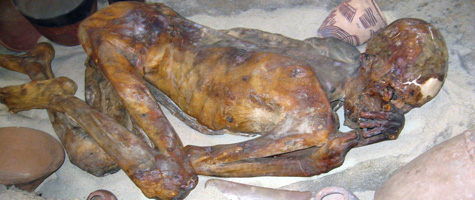
Ginger

Nicknamed for its red hair, "Ginger" is the most famous of six naturally mummified bodies excavated in the late 19th century from shallow graves in the Egyptian desert. It went on display at the British Museum in 1901, becoming the first mummy to be exhibited in public, and has stayed there ever since. Ginger and the other bodies found with it are the oldest known mummies in existence, dating back to about 3400 B.C. Artificial mummification was not yet a common practice at the time of their deaths, but their bodies were naturally dried and preserved by the warm sand in which they were buried.

Hatshepsut
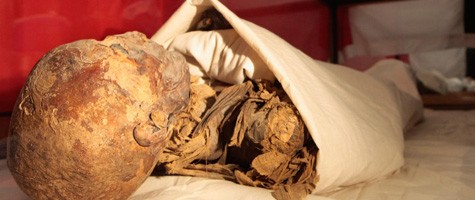
Female pharaoh, Hatshepsut

The most prominent female pharaoh, Hatshepsut reigned over Egypt for roughly two decades, undertaking ambitious building projects and establishing valuable new trade routes until her death in 1458 B.C. The archaeologist Howard Carter discovered her royal tomb in Egypt's Valley of the Kings in 1902. When he located her sarcophagus some years later, however, it was found to be empty. Carter also unearthed a separate tomb, known as KV60, which contained two coffins: that of Hatshepsut's wet nurse–identified as such by an inscription on its cover–and that of an unknown female. In 2006, a team led by Dr. Zahi Hawass set out to determine whether the anonymous woman in KV60 could be the missing queen herself. The vital piece of evidence was a molar tooth found in a wooden box bearing Hatshepsut's name. When Awass and his colleagues compared the tooth to a gap in the mummy's upper jaw, it was a perfect fit, leading the researchers to conclude that the search for Hatshepsut was finally over.

King Tutankhamen
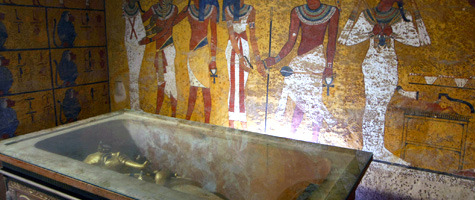
King Tut

Ancient Egypt's "boy king" became pharaoh at the age of nine and ruled for approximately 10 years (c. 1333-1324 B.C.). Relatively obscure during his lifetime, Tutankhamen–or "King Tut"–became a household name in 1922, when the archaeologist Howard Carter found his remarkable tomb in Egypt's Valley of the Kings. Despite several apparent grave robberies, the tomb was crammed with a wealth of ancient treasures, including jewelry, gilded shrines and a solid gold funerary mask. The discovery prompted a worldwide fascination with Egyptology in general and Tutankhamen in particular. Carter's partner and financier, Lord Carnarvon, died of an infected mosquito bite several months after the pair opened the tomb. His death inspired the myth of the mummy's curse, according to which anyone who dared intrude upon King Tut's grave would suffer his wrath.

Ramesses II
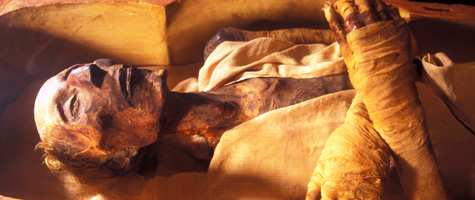
Ramesses II

Regarded by many historians as Egypt's most powerful pharaoh, Ramesses II reigned for six decades (c. 1279-1213 B.C.), lived to be over 90 years old and is said to have fathered upwards of 100 children. His body was originally entombed in the Valley of the Kings, as was customary for a pharaoh, but ancient Egyptian priests later moved it to thwart rampant looters. In 1881, Ramesses II's mummy was discovered in a secret royal cache at Deir el-Bahri, along with those of more than 50 other rulers and nobles. In 1974, archeologists noticed its deteriorating condition and flew it to Paris, where it was treated for a fungal infection. Before the journey, Ramesses II was issued an Egyptian passport, which listed his occupation as "King (deceased)."

Valley of the Golden Mummies
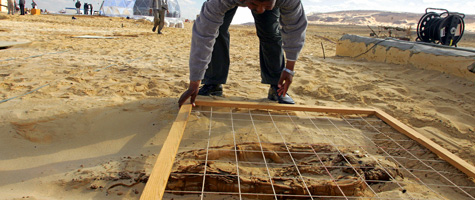
Bahariya Oasis

Located in Egypt's Western Desert, the Bahariya Oasis was a major agricultural center during ancient times and is now home to several archaeological sites, including a Greek temple dedicated to Alexander the Great. In 1996, an antiquities guard was riding his donkey on the temple's grounds. Suddenly, the donkey's leg stumbled into a hole, revealing an opening in the desert floor and the edge of a tomb. A team of archaeologists led by Dr. Zahi Hawass began excavations of the site, known as the Valley of the Golden Mummies. The first few expeditions have uncovered several hundred mummies that date back to Egypt's Greco-Roman period, as well as a treasure trove of artifacts. The diversity of the mummies' adornments suggests that the site served as the final resting place for every level of society, including wealthy merchants, members of the middle class and poorer inhabitants. Hawass estimates that as many as 10,000 additional mummies may be lying under the sand.

Taken From: http://www.history.com/shows/chasing-mummies/interactives/mummies-facts-infographic [18.04.12]

Go to Egypt and see a Mummy for yourself. Check out our very affordable Egypt packages, just click here.

Monday, April 16, 2012

Did you know? The Anglo-Zanzibar War was the shortest war ever.

The Sultan's harem after the bombardment.
 
Khalid bin Bargash
Sultan Hamad bin Thuwaini
The Anglo-Zanzibar War was fought between the United Kingdom and Zanzibar on 27 August 1896. With a duration of only 45 minutes, it holds the record of being the shortest war in recorded history. The war broke out after Sultan Hamad bin Thuwaini, who had willingly co-operated with the British colonial administration, died on 25 August 1896, and his nephew, Khalid bin Bargash, seized power in what amounted to a coup d’état. The British favoured another candidate, Hamud bin Muhammed, whom they believed would be easier to work with, and delivered an ultimatum ordering Bargash to abdicate. 

Hamud bin Muhammed
British sailors pose with a captured
cannon outside the sultan's palace
Bargash refused. While Bargash’s troops set to fortifying the palace, the Royal Navy assembled five warships in the harbour in front of the palace. The British also landed parties of Royal Marines to support the “loyalist” regular army of Zanzibar. Despite the Sultan’s last-minute efforts to negotiate for peace via the U.S. representative on the island, the Royal Navy ships opened fire on the palace at 9 am on 27 August 1896 as soon as the ultimatum ran out. With the palace falling down around him and escalating casualties, Bargash beat a hasty retreat to the German consulate where he was granted asylum. 

The palace complex following the
bombardment
The shelling stopped after 45 minutes. The British demanded that the Germans surrender the erstwhile Sultan to them, but he escaped to sea on 2 October 1896. He lived in exile in Dar es Salaam until captured by the British in 1916. He was later allowed to live in Mombasa where he died in 1927.


Zanzibar Town under "Attack", 27 August 1896

Around 500 Zanzibari men and women were killed or wounded during the bombardment, most of the dead a result of the fire that engulfed the palace. As a final act, Britain demanded payment from the Zanzibar government to pay for the shells fired on the country.


Sources: Wikipedia
Taken from: http://en.wikipedia.org/wiki/Anglo-Zanzibar_War [16.04.12]


Wednesday, April 4, 2012

Jambo! - Mombasa, Kenya

Story by Nicky Furniss taken from the Aboutime Magazine March 2012. 


When the very first scheduled 1time flight to Mombasa, Kenya, touched down at Moi International Airport recently, it was met by a tumultuous welcome. Fire engines sprayed the plane with a salute of water, while enthusiastic dancers and Kenyan dignitaries greeted the passengers as they exited the plane. As the very first direct flight from anywhere on the African continent to Mombasa, this was indeed an auspicious occasion. But – as the warm smiles and shouts of “jambo!” we received over the following days bore testament to – special occasion or not, all visitors to Kenya are guaranteed a very warm welcome.
 
The Island City
Kenya’s second largest city, Mombasa is located on Mombasa Island and has been an important trade and port city since its first estimated origins in 900 AD. These days it still serves as Kenya’s only major seaport and as such, it is a bustling hub of activity. The city boasts a diverse population of Mijikenda and Swahili people, as well as immigrants from the Middle East, Somalia, Pakistan and India, many of whose ancestors were drawn here centuries ago by the spice, gold and ivory trades. As a result, the city is a delightful mix of architectural styles, and Hindu and Muslim temples nestle comfortably beside Christian churches.

Visitors can relive some of the city’s long history by wandering around Mombasa’s Old Town or visiting Fort Jesus, which was built by the Portuguese in 1593 to protect the old port. In 2011, Fort Jesus was declared a UNESCO World Heritage Site in recognition of the fact that it is considered to be one of the world’s best preserved examples of 16th century Portuguese military fortifications.

Sun, Sea and Sand
Despite its long history and vibrant multiculturism, Mombasa’s main tourist attraction is undoubtedly its spectacular beaches, lapped by the same warm, crystal clear waters as its more famous beach holiday neighbour, Zanzibar. Sandy white beaches stretch out along the coast on both sides of the city, but we headed south to Diani Beach, a popular resort town just 30 km south of the city. Here a proliferation of luxury resorts – including ours, the Neptune Paradise Village – have made the most of the tropical location, with inviting loungers reclined under swaying palm trees, as well as plenty of powder white sand to lay your beach towel on.

Diani Beach stretches for 25 km down the southern Kenyan coast, much of which is protected by coral reefs. The reefs ensure calm waters, perfect for swimming, and are also a destination in themselves for snorkelers and divers (most resorts in the area have dive operators). The calm water and constant breeze also make this stretch of coastline a favourite with kite surfers, and at any given time of day you are likely to see the horizon filled with multi-coloured kites skidding their riders on the surf behind them. Locals in traditional dhows are also often on hand to take paying customers on sailing trips along the coast where, if you are lucky, you may happen across a pod or two of dolphins.
Even easier to spot are the bands of cheeky black and white Colobus monkeys that play in the resorts’ many trees. And if windows are left open, they have no qualms about casing your room for tasty titbits (and in our case that included the soap!). Speaking of tasty titbits, the hotels here are spoilt for choice in terms of tropical fruit and fresh-as-it-comes seafood, and the evening buffet tables are often groaning under the weight of giant lobsters, seared tuna and barbequed prawns.

While Diani’s resorts cater to every conceivable need, it would be a waste not to venture out at least once or twice to see what else the area has to offer. We signed up for a day trip with Intra Safaris to the Kisite-Mpunguti Marine National Park, one of Kenya’s nine marine reserves. An hour-long bus ride brought us to the little town of Shimoni. As well as being a convenient boat launching point for the marine reserve, it also has another rather dubious distinction: that of once being a key port from which slaves were shipped all over the world. Visitors can join a guided tour of the Shimoni Slave Caves to learn more about this sad part of Kenya’s history, before heading out on traditional dhows to experience the more pleasant attractions of the marine park. The park’s protected waters often play host to pods of dolphins and its many reefs (teeming with soft and hard corals and brightly coloured tropical fish) are a joy to explore, both for snorkelers and divers.

There are also a number of islands in the reserve, and we stopped for a delicious lunch of local delicacies at Wasini Island. Here we also had the option to while away the afternoon in the lagoon pool, or explore the mangroves via the Wasini Women’s Boardwalk, a local community support programme.

The Gateway to Kenya
With the launch of 1time’s new route to Mombasa, South Africans will now have a completely new beach destination to explore, complete with palm trees, friendly locals and a picture perfect coastline. Mombasa is also the perfect launch pad from which to explore the rest of Kenya, including the famed Masai Mara, snow capped Mount Kenya and the Rift Valley, thanks to domestic flights linking Mombasa and Diani (which boasts its own airport) to many of these attractions.

The Kenyan government is also hard at work to make the country more accessible and attractive to foreign tourists. According to the Kenyan Minister of Tourism, the honourable Mr Balala, a number of highways and roads linking Nairobi to the country’s major tourist attractions have been upgraded, and there are plans to begin work on a bypass that will link Mombasa to Diani and the southern coast. This will effectively bypass the need to take a car ferry (which currently adds about half an hour to the trip to Diani), and will make the south far more easily accessible. There are also plans to upgrade many of the country’s airports.

With the wholehearted support of the Kenyan Government, 1time’s new route to Mombasa will now make it possible for South African tourists to explore even more of the African continent, and to add their voices to those of their welcoming hosts with enthusiastic cries of: “Jambo!”

A Couple of Good Reasons to Visit Kenya
- Kenya boasts 59 national parks, including the famed Masai Mara National Reserve
- The country offers a host of diverse cultures (42 different languages are spoken here)
- Kenya boasts 480 km of white beaches and 240 km of protected coral reefs
The country has no less than 38 golf courses

Story by Nicky Furniss taken from the Aboutime magazine March 2012.